
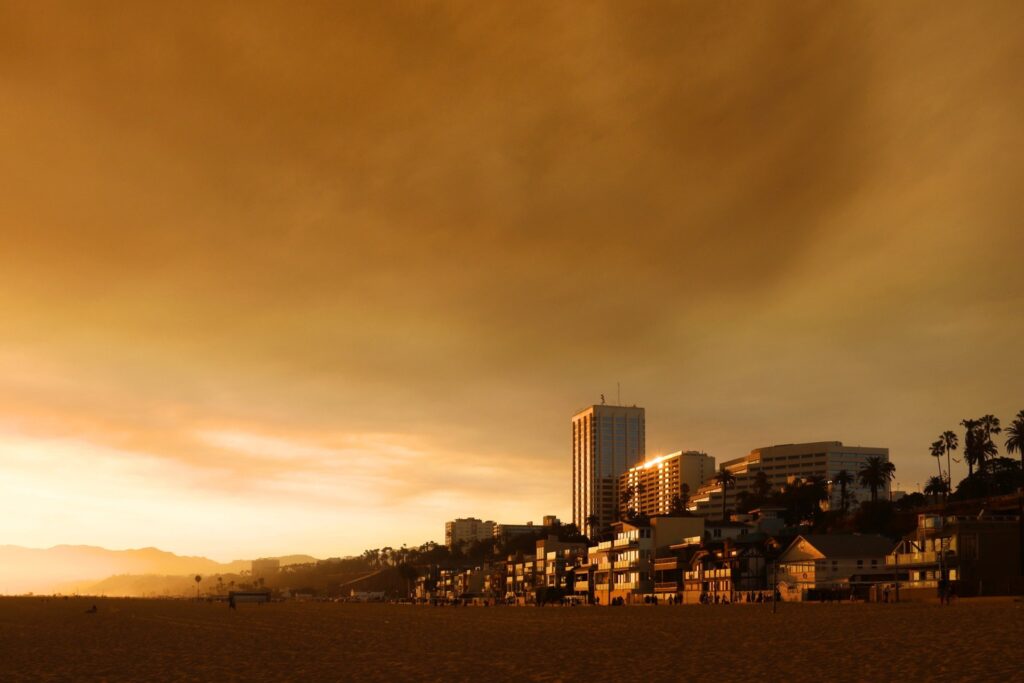
In Los Angeles, wildfire smoke can become a workplace issue even when the fire itself is miles away.
South Coast AQMD notes that wildfire smoke can affect air quality far from the source, and smoke and ash conditions can change quickly. For businesses, that means a smoky day can bring more than an unpleasant smell. Fine particles can make their way indoors, ash can settle on surfaces, and dirt can be tracked through entrances and high-traffic areas.
Cleaning is only one part of a broader smoke-response plan, but it is an important one. For Los Angeles businesses, the goal is to reduce indoor buildup, protect shared spaces, and make sure the cleaning plan supports the building’s larger air-quality strategy.
The front door is one of the easiest places for outdoor debris to make its way inside.
EPA guidance recommends using doormats and cleaning them regularly to help reduce ash being tracked into indoor spaces.
For Los Angeles offices, property managers, and HOA communities, that can mean paying extra attention to:
During smoky or windy conditions, these areas may need attention more often than they do during a typical week.
For South Bay properties, the challenge can be a mix of everyday sand, dust, and outdoor debris plus whatever the wind brings in. Keeping entrances under control helps prevent that buildup from spreading farther into the building.
When ash or fine dust is present, aggressive dry cleaning can make the problem worse by sending particles back into the air.
South Coast AQMD advises against dry sweeping or using leaf blowers around ash. EPA guidance recommends damp cloths or wet mops for lightly dusted indoor surfaces.
That changes the cleaning approach.
Instead of simply sweeping visible dust, teams may need to:
This is an important distinction for businesses because wildfire residue is not the same as ordinary office dust.
If a property has significant ash contamination or fire damage, follow local public health guidance and bring in qualified remediation professionals.
Vacuuming is usually a standard part of office cleaning, but during a smoke event, the type of equipment matters.
EPA and South Coast AQMD guidance recommend HEPA-filtered vacuums when cleaning dusty or ash-affected indoor areas. Standard vacuuming can stir fine particles back into the air if the equipment is not designed to capture them effectively.
For facilities teams, this is a good question to ask your cleaning provider:
What type of vacuum equipment is being used in carpeted areas during smoke events?
Carpets and rugs can collect particles that enter through doors, shoes, clothing, and ventilation. Using appropriate equipment helps remove that buildup without unnecessarily redistributing it.
Cleaning cannot solve indoor air quality on its own.
Los Angeles County Public Health and South Coast AQMD recommend steps such as keeping windows and doors closed during smoky conditions, using HVAC systems appropriately, and improving filtration where possible.
That means cleaning teams and facilities teams should be working toward the same goal.
For example:
South Coast AQMD also recommends MERV-13 or higher filtration where the HVAC system can accommodate it, while EPA recommends portable air cleaners or other filtration strategies during smoke events.
Those decisions belong with building management or HVAC professionals, but the janitorial plan should complement them, not work against them.
The sky can look better before the building is fully clean.
Ash and fine dust may remain on entry floors, windowsills, furniture, carpets, and other surfaces after outdoor air quality improves.
That makes the post-smoke cleanup important.
A practical walkthrough might include:
South Coast AQMD notes that ash can be visible even when it is not reflected in AQI readings because larger particles may not be captured by air-quality monitors.
For property managers, that is a useful reminder: if you can see ash, the space may still need attention even after the air-quality map looks better.
Los Angeles businesses deal with conditions that are not always reflected in a standard janitorial checklist.
Wildfire smoke. Windblown dust. Coastal sand. Heavy traffic through shared entrances.
A good cleaning plan should be flexible enough to respond when those conditions change.
For more than 35 years, K&P Janitorial Services has served businesses and properties throughout the South Bay and greater Los Angeles area. We understand that some weeks require more attention than others and that a reliable cleaning plan should be able to adjust.
If smoke, ash, or seasonal conditions are changing what is happening inside your property, it may be time to review whether your current cleaning schedule and equipment are keeping up.
K&P Janitorial Services | (310) 540-8878 | customerservice@kandpjanitorial.com | kandpjanitorial.com